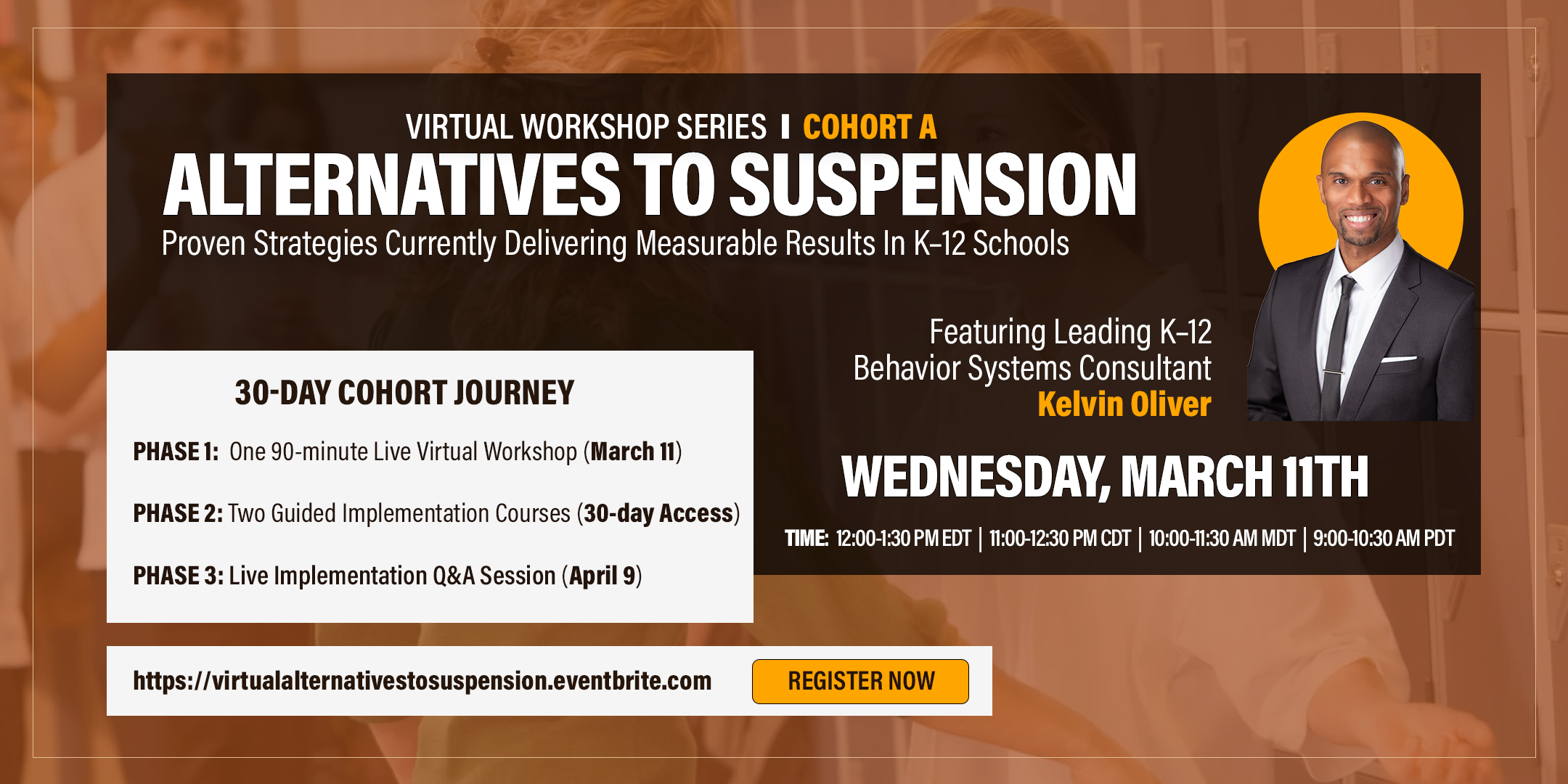
VIRTUAL WORKSHOP

ALTERNATIVES TO SUSPENSION

(Cohort A)

WEDNESDAY, MARCH 11TH

1:00-2:30 PM EDT | 12:00 PM-1:30 PM CDT | 11:00-12:30 PM MDT | 10:00-11:30 AM PDT

Workshop Overview

Most schools are caught in the costly cycle of suspending the same students over and over. Many have invested significant resources into discipline programs that interrupt behavior but don’t change it. Some rely heavily on consequences without teaching the skills students are missing. Others rely on conversation, reflection, and processing without building new capacity. In both cases, students return with the same deficits they had before the intervention, and the behavior repeats.

This virtual workshop delivers the same frameworks, implementation discipline, clear expectations, quality control, and enforcement as you would receive in our in-person Alternatives to Suspension training, without requiring schools to wait for an on-site opportunity to come to their city, state, or region. It provides a systematic approach to accountability that eliminates repetition by embedding verifiable teaching into every intervention. At the center of this workshop is the Teaching Fidelity Gate, a three-question diagnostic that exposes when teaching has been skipped, even when an intervention feels productive.

By the end of this workshop, participants will be able to distinguish between interventions that feel productive but don’t change behavior and those that actually change behavior, and design interventions that pass quality control before they reach students. This is not a theory training. This is an actionable framework for schools that are ready to stop the cycle and install accountability systems that hold.

Why Attend?

If your school is experiencing any of these patterns, this workshop provides the missing mechanism:

  • The same students repeatedly receive consequences with no behavioral change
  • Staff implement “restorative” or “trauma-informed” approaches that feel better but don’t reduce repeat referrals
  • Behavior interventions sometimes succeed temporarily, but most students regress within days
  • Your state requires alternatives to suspension, but it doesn’t provide guidance on what to do instead
  • Discipline decisions are inconsistent depending on the individual assigning the discipline

    This workshop will not:
  • Provide scripts for building relationships or validating feelings (those aren’t teaching)
  • Suggest that any consequences, including suspension, should be eliminated
  • Confuse accommodation with exemption when addressing students with trauma histories (empathy doesn’t invalidate expectations)

    This workshop will:
  • Show you exactly how to verify whether teaching occurred inside any intervention
  • Give you a quality control system that prevents implementation drift before it happens
  • Eliminate the gap between “we tried that, and it didn’t work” and understanding why it didn’t work

Format

This 90-minute live session establishes the core frameworks that everything else builds on. This is not a lecture or awareness session; it is enforcement training focused on how accountability actually works when teaching is present. 

Live attendance is required. To protect implementation fidelity, the live workshop is not recorded. The work relies on shared language, real-time framing, and collective calibration that does not translate to passive replay. 

Following the session, participants receive curated key takeaways, structured implementation notes, and tools designed to support application, without replacing the live experience.

Guided Implementation Period (30 Days)
After the live workshop, participants move into a structured implementation cycle supported by two self-paced application courses. These are not passive video libraries. They are guided implementation environments designed to clarify teaching, skill instruction, and accountability design.

Live Implementation Q&A
Wednesday, April 9 | 12:00–1:30 PM EDT
This live session is dedicated to troubleshooting real implementations using a consistent enforcement protocol. Every implementation question begins with: “What did you teach?”

What is a Cohort?

This isn't structured like a typical virtual or in-person workshop where you attend, take notes, and figure out implementation on your own without real-time support. It's a cohort, which means everyone learns the same frameworks in the live session, takes the same courses to learn the strategies, implements during the same 30-day window, and brings real scenarios to the Q&A, not hypothetical questions. That shared timeline creates something most trainings can't provide: collective calibration. When someone else's implementation gets corrected, you're not just learning from your own mistakes. You're learning to identify the same drift in your practice before it spreads. Because the cohort focuses on competence rather than information, we'll only be able to offer limited opportunities annually.


What's Included

Registration includes the following components:

- One 90-minute live virtual workshop (March 11)
Establishes the full Alternatives to Suspension framework, including:
• The three approaches to addressing behavior
• Understanding behavior through a skill-based lens
• The Teaching Fidelity Gate (three non-negotiable questions)
• Highly Effective Accountability (Consequence + Teaching + Incentive)
• How alternatives to suspension fail when teaching is skipped
Live attendance required. The session is not recorded.

- Two guided implementation courses (30-day access)
These courses are designed for application, not consumption, and include Teaching Fidelity Gate checkpoints, weak vs. strong examples, and enforcement prompts.
Course 1: Unstructured Environments
Strategy focus:
• Structured Day
• Accountability Projects
• Character Connections
Course 2: Teacher–Student Conflict
Strategy focus:
• 3 T’s
• Reflections Room
• How to Ask the Right Questions
Each strategy requires participants to identify the skill being taught, how instruction and practice will occur, and how learning will be verified, before implementation.

- One live Implementation Q&A session (April 9)
• Enforcement-focused troubleshooting
• Real scenarios from participants
• “What did you teach?” protocol applied consistently
• Designed to prevent implementation drift before it spreads
Live attendance required. The session is not recorded.

- Curated implementation materials
Participants receive:
• Key takeaways from live sessions
• Teaching Fidelity Gate checklists
These materials support the application without replacing live participation.

- One month of Explorer membership access
All participants receive one month of access to the Explorer membership tier, providing continued exposure to aligned resources, frameworks, and implementation supports following the workshop.

Cost of Registration

Individual: $375 per participant/login
  • This is our base price without a discount but still a great value.
Team Registration: $1,500 - up to 5 participants/logins ((≈ $300 per login)
  • With a Team Registration, you’ll receive five logins for this virtual workshop. This option is perfect for principals who want to include their assistant principals, deans, behavior support staff, or leadership team members in the training.

All Registrations End Friday, March 6th at 11:59 pm EDT.

Who Should Attend

This workshop qualifies as implementation-focused professional learning for administrators, behavior teams, and educators responsible for discipline decisions.

This workshop is designed for:

• School administrators (principals, assistant principals, deans)
• Behavior specialists, interventionists, and MTSS team members
• Counselors and student support staff who are involved in discipline decisions
• Leadership teams that are responsible for reducing suspensions and repeat referrals
• Individual educators implementing behavior interventions in their own sphere

This workshop is built for teams. But if you’re on your own, you can still use the system in your own classroom or sphere of influence.
Write your awesome label here.

Frequently Asked Questions

Will I receive any supporting resources if I attend the workshop?

Yes! Every registered participant will gain access to complimentary resources and support as part of the workshop experience. These materials and opportunities are designed to help you put the strategies into action with confidence when you return to your campus. For group registrations, each paid participant will receive their own access.

When will I receive my supporting resources?
  • Paid in full before the workshop: Expect your resources within two weeks after the workshop concludes.
  • Registered with a purchase order (PO): Resources will be delivered within two weeks after payment is received.

[In-Person Workshop Only] Will meals be provided either or both days of the workshop?

We've allotted one hour and 15 minutes for workshop attendees to have lunch on their own. Because most attendees work on a campus with students, they are rarely afforded the opportunity to go to a restaurant for lunch. Our hope is that each attendee takes advantage of this unique opportunity to enjoy a sit-down lunch like most other working professionals are able to do. Throughout both days, beverages such as coffee, water, and hot tea will be available to all participants. 

What's the cancellation/refund policy for this workshop?

If you are unable to attend the workshop, please submit your refund request in writing at least seven (7) days before the scheduled event start date. You can send your request to billing@leavingthevillage.com.

Requests made within seven (7) days of the workshop start date will not be eligible for a refund; however, you can request a credit, Rain Check, that may be used toward a future LTV learning opportunity.

Will I be able to earn CEUs if I attend this workshop?

Unfortunately, we can't guarantee that you will be able to receive continuing education units if you attend our workshops. We offer our workshops around the country and we are in the process of ensuring our attendees can earn credits in the future.

Is this workshop beneficial for elementary educators?

Our workshops are differentiated to meet the needs of all levels, K-12. With that said, Kelvin Oliver, the presenter, was a PK-6 campus administrator when he implemented Restorative Practices on a campus. His time as a campus administrator is where he developed many of the concepts that are presented during these workshops. While the focus will be on all grade levels, elementary educators will not walk away from this workshop feeling that it didn't apply to them.

Are these workshops only intended for administrators?

No, you don't have to be an administrator to attend these workshops. All educators that attend these workshops will find great benefit in these workshops.